
Here we are again, in the 17th of Tammuz. The day that kicks off all the bad stuff about Jewish history. Well, the defeats, the mistakes, the events in which things broke and were destroyed.
It seems that in the past few years, more and more things have been breaking, and at an ever-increasing pace. Ideas and conceptions about Israel’s role in the world, our connection to the land of Israel, religious ideas, and leadership, not to mention politics, and the danger of civil war. And then there’s the world at large — globalization, technology, A.I.… need I say more?
In Judaism, we don’t commemorate the past. We revisit the ideas that brought us to where we are today. The past is a lens, a way to learn from it, and a reminder that some fundamental issues have not been solved yet (Rambam, Hilchot Ta’aniot, chapter 5). Whether it’s the shattering of the tablets during the sin of the Golden Calf — an icon we erected for ourselves — or the shattering of the walls of Jerusalem — the icon we thought would outlast the Romans. These are paradigms that had to be shattered, for us to be free.
Is Artificial Intelligence the same? How many jobs will be lost, industries shattered, because we can’t adjust to a new reality? Perhaps this connection is too symbolic — A.I. isn’t a sin. But the instinct behind it is the same one our fast day is pointing to: our constructs are never infallible, and our security is always tenuous, at best. What changes do we have to go through, as individuals and as a society, to grow and to become better? Keep that question in mind, because it’s exactly the question that drives the story I actually want to tell.
I want to discuss a transition, a paradigm shift, that changed the world, and impacted the kingdoms of Israel and Judah. I’m speaking about the Age of Empires — and this year, I’m running my flagship tour of the same name, rebuilt around a brand-new exhibition at the Bible Lands Museum, Jerusalem.
עידן האימפריות
In the world of the Kings of Israel and Judah, also known as Iron Age II, empires were a new paradigm. Iron Age II runs roughly from the kingdom of David and Solomon, about 2,900 years ago, until the destruction of the First Temple in 586 BCE, according to conventional chronology. During that time, the region was made up of regional kingdoms: Israel, Judah, Aram, Ammon, Moab, Edom. (Their Bronze Age predecessors were city-states — a different political structure entirely, and a story for another day.) Assyria was the first of these regional powers to become a true world empire.
Historians call this the Neo-Assyrian period, because Assyria beforehand was a powerful kingdom, but not an empire. After this came the Neo-Babylonian empire, which defeated the Assyrians. Then came the Persian Empire, the Hellenistic empires of Alexander and his successors, and so on. I recommend this concise TedEd video as an introduction to the subject:
But what’s the difference between a kingdom and an empire?
I owe thanks to a few people for helping me come up with the following two metaphors, which I’ve used maybe hundreds of times on my tours.
Fashion: Dior vs. Zara
Dior, Chanel, Hermès — these are staples of haute couture. The fancy clothes that the rich and famous can afford, as the annual Met Gala demonstrates. Hundreds of hours can go into a single dress, many people working on many aspects of it. From the design to production, embroidery, stitching, expensive materials — these are skills that even the most advanced automated machines can’t compete with.
And then there’s Zara.
Enter a product of globalization, where production and manufacturing happen across the world, with cheap labor and fast machines. The quality isn’t the same, true. The prestige isn’t comparable, true. But would you rather spend $2,000 on a Dior bag, or $60 on a knockoff from Zara?
An empire, in short, uses global expansion and networks to enable faster and cheaper trade, production, and availability. And of course, this threatens the regional powers, who want that competition out.
Could this be why Ahaz king of Judah wanted to join the Assyrian empire? Could this be why Pekah king of Israel and Rezin king of Aram attacked him for it? (II Kings 17, Isaiah 7)
Sports: Moneyball
The second aspect of empire is warfare. The “Assyrian war machine” is the term often used for the sophisticated system behind the Assyrian army. The previous model was the regional kingdom’s army — Israel, Judah, Aram, even Egypt each fielded powerful forces, with their own divisions of combat, occasionally banding together in coalitions with or against other kingdoms.
We have an amazing example of this in the Kurkh Monolith in the British Museum, which mentions Ahab, king of Israel, in a coalition of kings against Assyria at the Battle of Qarqar (853 BCE). Coalitions were the way to go — but empires are a completely different ball game.
Moneyball (2011) is a fantastic movie about a similar paradigm shift, in sports. Free agency and sports analytics redefined how to win a game — not with brute force or superstars, but with a sophisticated system of players chosen by analytics. Billy Beane of the Oakland Athletics implemented this system, and it eventually helped bring the Red Sox their first World Series win in 86 years. This idea changed how sports was done.
The Assyrian Empire did to warfare what Moneyball did to sports.
And the regional powers of the time didn’t see it coming. The kingdom of Israel was destroyed, its population exiled. The kingdom of Judah got temporary relief — but Hezekiah was attacked, and his kingdom nearly went the same way.
Lachish, briefly
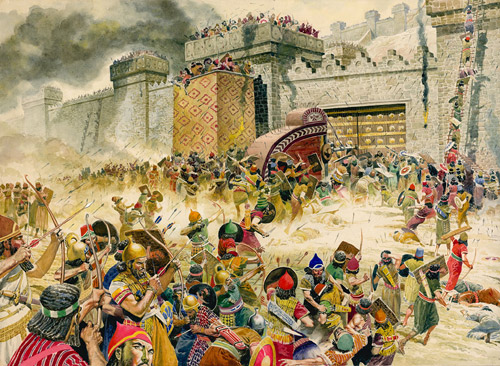
Nowhere does that “nearly” hit harder than at Lachish — the second most important city in the kingdom of Judah, after Jerusalem itself. I’ve written about this before: my time on Professor Yossi Garfinkel’s excavation, standing on the Assyrian siege ramp Sennacherib’s engineers built in 701 BCE — the same siege the Lachish reliefs, now in the British Museum, depict in vivid detail. A century later Jeremiah would name Lachish and Azekah as the last fortified towns still standing against Babylon (34:7). It’s also worth knowing there’s now a genuinely good visitor center on site, if you want to see it for yourself.
As Soon as the War Is Over
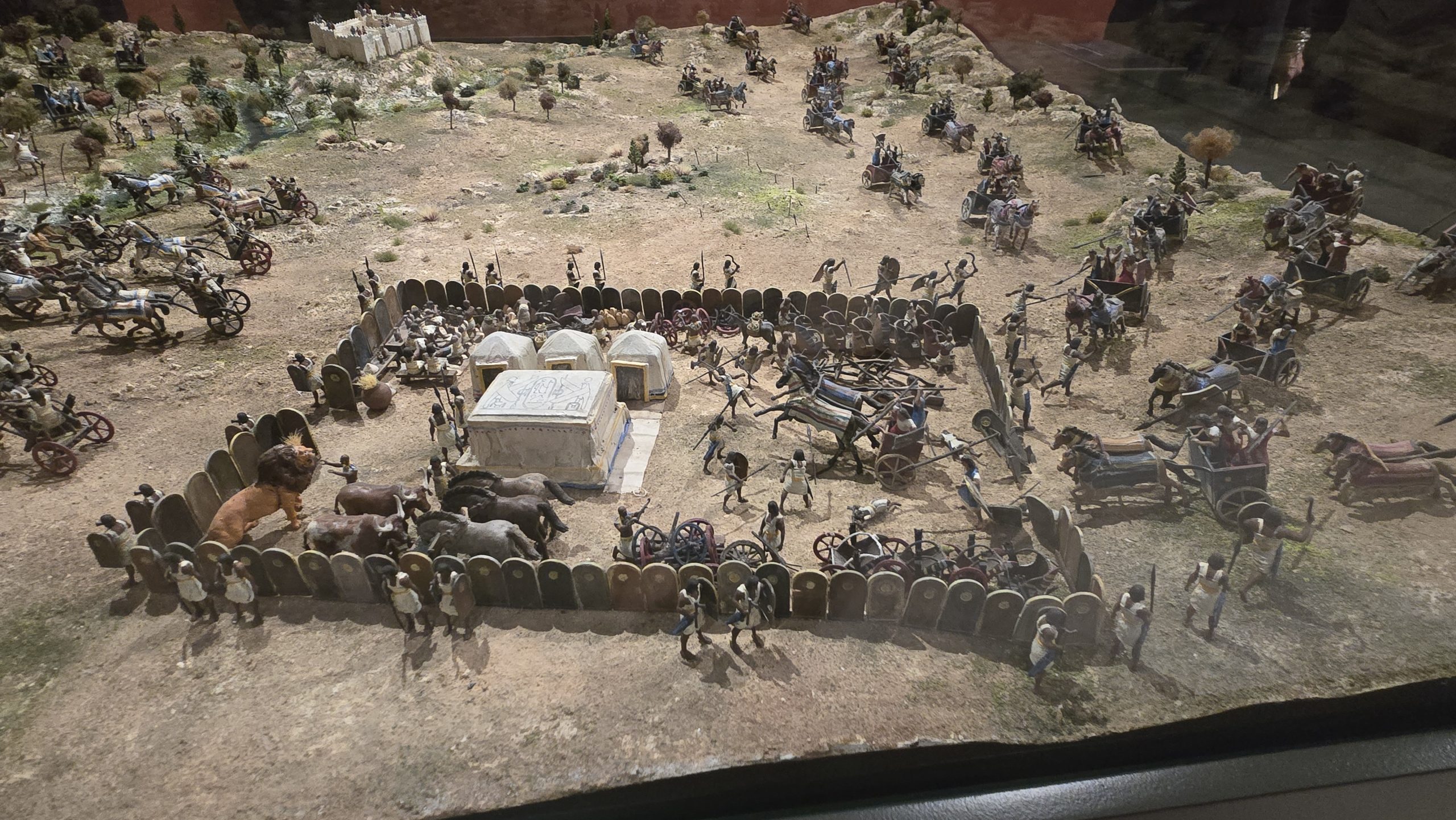
All of which is exactly why the Bible Lands Museum’s new exhibition stopped me in my tracks. As Soon as the War Is Over tells the story of Assyria’s attack on Judah in 701 BCE alongside two more epic historic battles — the Battle of Kadesh, and the Trojan War — and lands, finally, on the Pax Romana: the Roman peace, built on a network of roads, a flexible army, consumerism, and a punishing taxation system. Peace, in other words, purchased through strength and extraction both. But at least the wine was good, they say.
Speaking of which, you probably know the famous Monty Python line “What have the Romans ever done for us?” — but did you know it’s originally from the Talmud? B. Shabbat 33b is the background to the famous story of Rabbi Shimon bar Yochai fleeing to a cave — a story that begins with the same uncomfortable question the exhibition asks: what does peace cost, and who’s paying for it?
That question is the whole reason the Three Weeks matter. Rome is Edom is Esav — and the discomfort of “peace” bought at the price of Jewish sovereignty is not a Second Temple problem, it’s the problem this period asks us to sit with every year. America’s impact on Israel’s independence today, and her decisions made in war, are often seen as connected thematically to Rome and Jerusalem.
In this year’s version of my flagship Age of Empires tour, I’m building around this exhibition. We’ll walk the three battles it’s built on: Kadesh (Hittites vs. Egypt — regional kingdom vs. regional kingdom, before empires existed at all), Lachish (Sennacherib vs. Hezekiah — empire arrives), and Troy (Greece — hugely important to the story, but notably not yet an empire itself at this point).
We’ll also visit Babylon in the permanent galleries — home now to the Al-Yahudu documents, cuneiform tablets recording the daily lives of Judean exiles in Babylonia, which until recently sat in the museum’s temporary “By the Rivers of Babylon” exhibit and have now moved into the permanent collection. And more.
I hope to see you at the Bible Lands Museum on July 17, 19, and 26, with sessions for families and for adults, and more dates will open up through August.
And meanwhile, I’m posting here my virtual Age of Empires tour from the British Museum, along with other related virtual tours and articles, for your enjoyment.
May we celebrate next year in a rebuilt Jerusalem, in the festival of the 17th of Tammuz.
Related Reading
- Lachish: The Last Stand
- Taharqa, Sennacherib and Hezekiah — The Untold Story
- Wine and Prophecy: The Rebirth of Shomron (Part 1 of 4)
- How Lost Are the Ten Tribes? Rebirth of Shomron (Part 2 of 4)
- Tasting and Torah in Shomron: Interview & Wine Story (Part 3 of 4)
- Build Up Israel — Rebirth of Shomron (Part 4 of 4)
- Lions, Oh My!
- Babylon: Unearthing Impact
- Age of Empires Tanach Tour
Related Videos
- The Hen, the Goat, the Tree, and the Really Bad Butler — Tisha b’Av Stories for the Whole Family
- What Happened to the Jews After the Destruction of the First Temple? (FREE Intro Class)
- Why Didn’t We See October 7 Coming? Or — Why Were We NOT Surprised? (Tisha B’Av Discussion)
- Brothers or Enemies? Israel and the Western World’s Biblical Roots
- Tisha B’Av 2021 — Tour of Four Sites (Israel, Daytime)
- Keynotes of Kinot — A Virtual Tour for Tisha b’Av


