
The Antiquities Authority Knows Exactly What It Is Doing
Every year, right on schedule, the ancient world produces a headline that happens to match the calendar.
Coincidence? I think not.
Blog post for Tisha b’Av and Tu b’Av 5786 / 2026
The Israel Antiquities Authority is very good at public relations, and it does not particularly hide it. Two days before Purim 2019, it announced a Persian-period jar fragment shaped like a human face from the City of David — the press release opens with the words “In honor of Purim.” Twelve days before Hanukkah 2021, it announced a Hellenistic fortress burned by the Hasmoneans in the Lachish Forest, with the director quoted saying “in a few days, we will be celebrating Hanukkah.” Five days before Hanukkah 2022, it was a small wooden box of silver tetradrachms from a cave in Nahal Darga, read as the savings of a Jew who fled during the persecutions of Antiochus IV. And one week ago, two days before this fast, charred First Temple roof beams from the City of David, with the excavator saying plainly: “We are just before Tisha b’Av.”[1]
Sometimes the timing produces something better than a headline. In late February 2023 the IAA announced an ostracon from Tel Lachish inscribed “Year 24 of Darius” — the father of Achashverosh, days before Purim. Within forty-eight hours it retracted: a visiting scholar, a specialist in ancient Aramaic script, had scratched the letters herself as a demonstration and left the sherd on the site. The potsherd was genuinely ancient. Only the writing was not. Chief Scientist Prof. Gideon Avni put it in Hebrew better than any English release managed: מסתבר שנתקלנו ב’כתובת שהתחפשה’ — “it turns out we ran into an inscription that came in costume.”[2] Days before Purim. You can’t make this stuff up.
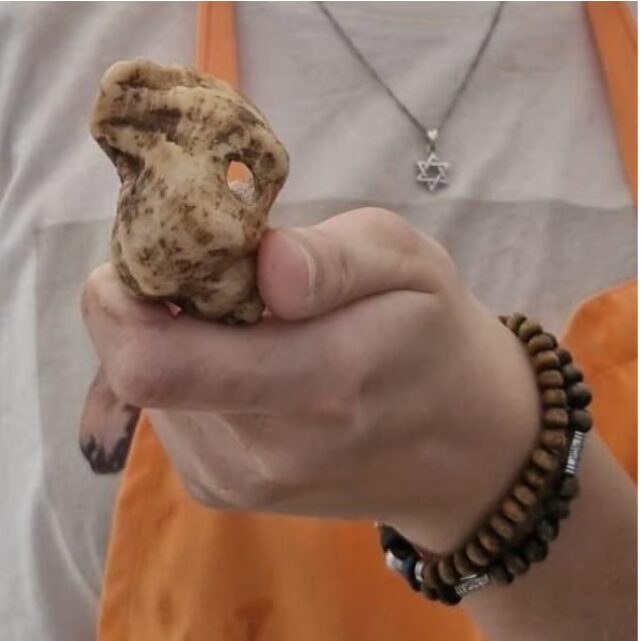
So it is no surprise at all that in the middle of the Three Weeks, the Israeli press was abuzz about… a snail.
A Snail in a Mikveh at Shiloh
On 12–13 July 2026, the Archaeology Staff Officer Unit of the Civil Administration, working with the Binyamin Regional Council, announced a find from Ancient Shiloh: an ornate Second Temple-period mikveh, a nearly intact Roman-period cooking pot resting inside it, and — the part that travelled — the shell of a murex, the sea snail from which the ancient world made its most expensive dyes.
Staff Officer Benjamin Har-Even said the quiet part out loud, and I mean that as a compliment: “We are in the period of the Three Weeks, when we commemorate the destruction of the Temple, and archaeological discoveries of this kind take on special meaning. Beyond their scientific importance, they illustrate the deep historical connection between the Jewish people and Ancient Shiloh.” He is a repeat offender, by the way — his unit announced an oil lamp from Nebi Samuel on the first night of Hanukkah last year.
Look closely at the photograph the unit released. The shell is broken open at the shoulder, in a very particular spot. It stands to reason that it was punctured in order to extract the gland that is used to produce the most valuable dye in the ancient world: Tekhelet (blue) and Argaman (purple). That is where the hypobranchial gland sits, and that is where a dyer opens the shell to reach it. At Tel Shikmona, where hundreds of dye-related artifacts have been excavated, shells broken precisely there are exactly what the workshop refuse looks like.[3]
A marine snail, deep in the hills of Ephraim and quite far from the sea, sitting in a Mikveh, in the town where the Mishkan stood for 369 years.[4] The fact that is was found in Shiloh ties not only to Tisha b’Av (9th of Av), when I started writing this post, but also to Tu b’Av (15th of Av), when I finally got around to finishing it. Shiloh is where women would dance in white, on Tu b’Av:
יוֹם שֶׁהוּתַּר שֵׁבֶט בִּנְיָמִין לָבוֹא בַּקָּהָל — the day Benjamin was allowed back in. And where did that happen? הִנֵּה חַג־ה׳ בְּשִׁלוֹ מִיָּמִים יָמִימָה — the annual festival at Shiloh, the dance in the vineyards, בְּנוֹת שִׁילוֹ (Judges 21:19–23).
In contrast with tekhelet and argaman, which express socioeconomic class, here there was a strive towards simplicity:
לֹא הָיוּ יָמִים טוֹבִים לְיִשְׂרָאֵל כַּחֲמִשָּׁה עָשָׂר בְּאָב וּכְיוֹם הַכִּפּוּרִים, שֶׁבָּהֶן בְּנוֹת יְרוּשָׁלַיִם יוֹצְאוֹת בִּכְלֵי לָבָן שְׁאוּלִין, שֶׁלֹּא לְבַיֵּשׁ אֶת מִי שֶׁאֵין לוֹ.
There were no days as joyous for Israel as the fifteenth of Av and Yom Kippur, for on them the daughters of Jerusalem would go out in borrowed white garments — so as not to shame the one who had none. (Mishnah Ta’anit 4:8)
But how does this story connect to Tisha b’Av?
Let’s work our way backwards from Tu b’Av:
יוֹם שֶׁכָּלוּ בּוֹ מֵתֵי מִדְבָּר — the day the deaths of the wilderness generation ended. That is the generation of the Spies. Tisha b’Av opens with their weeping; Tu b’Av is the day the sentence finishes running.
The essence of Tisha b’Av is the rejection of the Land of Israel, and the loss of both Temples in Jerusalem:
וּכְתִיב: “וַתִּשָּׂא כׇּל הָעֵדָה וַיִּתְּנוּ אֶת קוֹלָם וַיִּבְכּוּ הָעָם בַּלַּיְלָה הַהוּא”, אָמַר רַבָּה אָמַר רַבִּי יוֹחָנָן: אוֹתוֹ לַיְלָה לֵיל תִּשְׁעָה בְּאָב הָיָה. אָמַר לָהֶם הַקָּדוֹשׁ בָּרוּךְ הוּא: אַתֶּם בְּכִיתֶם בְּכִיָּה שֶׁל חִנָּם — וַאֲנִי קוֹבֵעַ לָכֶם בְּכִיָּה לְדוֹרוֹת.
And it is further written: “And all the congregation lifted up their voice and cried and the people wept that night” (Numbers 14:1). Rabba said that Rabbi Yoḥanan said: That night was the night of the Ninth of Av. The Holy One, Blessed be He, said to them: You wept needlessly that night, and I will therefore establish for you a true tragedy over which there will be weeping in future generations.
Taanit 29a
Let me weave the story together. There are several threads, and — this being a post about dye — they are all twisted around each other. Start with the blue.
The Blue Thread
The commandment itself comes at the end of Parashat Shelach:
דַּבֵּר אֶל־בְּנֵי יִשְׂרָאֵל וְאָמַרְתָּ אֲלֵהֶם וְעָשׂוּ לָהֶם צִיצִת עַל־כַּנְפֵי בִגְדֵיהֶם לְדֹרֹתָם וְנָתְנוּ עַל־צִיצִת הַכָּנָף פְּתִיל תְּכֵלֶת׃
Speak to the Israelite people and instruct them to make for themselves fringes on the corners of their garments throughout the ages; let them attach a cord of blue.
Numbers 15:38
Tekhelet appears some forty-nine times in Tanakh — the curtains of the Mishkan, the garments of the High Priest, and this thread on the corner of an ordinary person’s clothing—tzitzit. It became so bound up with the tallit that when the modern State of Israel designed a flag, it reached for those stripes.
Here is the part that still surprises people. Tekhelet and argaman — the blue and the royal purple — come from the same animal. Three species of the family Muricidae were used around the ancient Mediterranean: Hexaplex trunculus (ארגמון קהה-קוצים, the banded dye-murex), the one reportedly identified at Shiloh, Bolinus brandaris (ארגמון חד-קוצים, the spiny dye-murex), and Stramonita haemastoma (ארגמנית אדומת-פה, the red-mouthed rock shell).
The Hebrew word for the creature is חִלָּזוֹן — today it simply means “snail,” but it’s also been called a “purple-fish” by a Byzantine geographer, below. It’s a sea creature, bottom line.
What separates the blue from the purple is not the snail. It is light. In 1980 Prof. Otto Elsner of Shenkar, working with Prof. Ehud Spanier of the University of Haifa, established that exposing the dye vat to sunlight while the dye is in its reduced state converts dibromoindigo — the red-purple compound — into plain indigo. Dye in the shade and you get argaman. Dye in the sun and you get tekhelet.[5] This process had been lost for at least a millennium, and its rediscovery is a big deal.
I have a personal thread in this. The knowledge of how to make tekhelet was lost for roughly a thousand years and recovered, in our lifetime, by a small group of stubborn people: Rabbi Eliyahu Tavger, Dr. Baruch Sterman, Dr. Ari Greenspan and Joel Guberman, who built Ptil Tekhelet at Kfar Adumim in the early 1990s, drawing on Otto Elsner’s chemistry, Prof. Zvi Koren’s analysis of ancient textiles and Prof. Zohar Amar’s historical work. When Joel heard I was getting married, he gave me the tekhelet for the tallit my wife gave me under the chuppah.
The Purple People
The people of Israel are known as Am Segulah – עַם סְגֻלָּה, which in modern Hebrew sounds like “a purple nation”. But while this use of the word segulah has little to do with purple and more to do with treasure[7], there are indeed a “purple nation” we know about: The Phoenicians.
“Phoenician” is not what the Phoenicians called themselves. The Greeks called them Phoinikes (Φοίνικες), and the most common explanation is that the word carries the sense of red-purple — the coastal people identified entirely with the thing they sold.
They brought the industry south into Canaan. Tel Dor, at the southern end of the Phoenician coastal world, is one of the clearest cases. The Byzantine geographer Stephanus of Byzantium preserves a line from Claudius Iolaus: “Next to Caesarea lies Dor, a very small town inhabited by Phoenicians. These settled here because of the somewhat rocky nature of the beaches and the abundance of the purple-fish.” An ancient writer explaining, without being asked, exactly why the town is where it is.
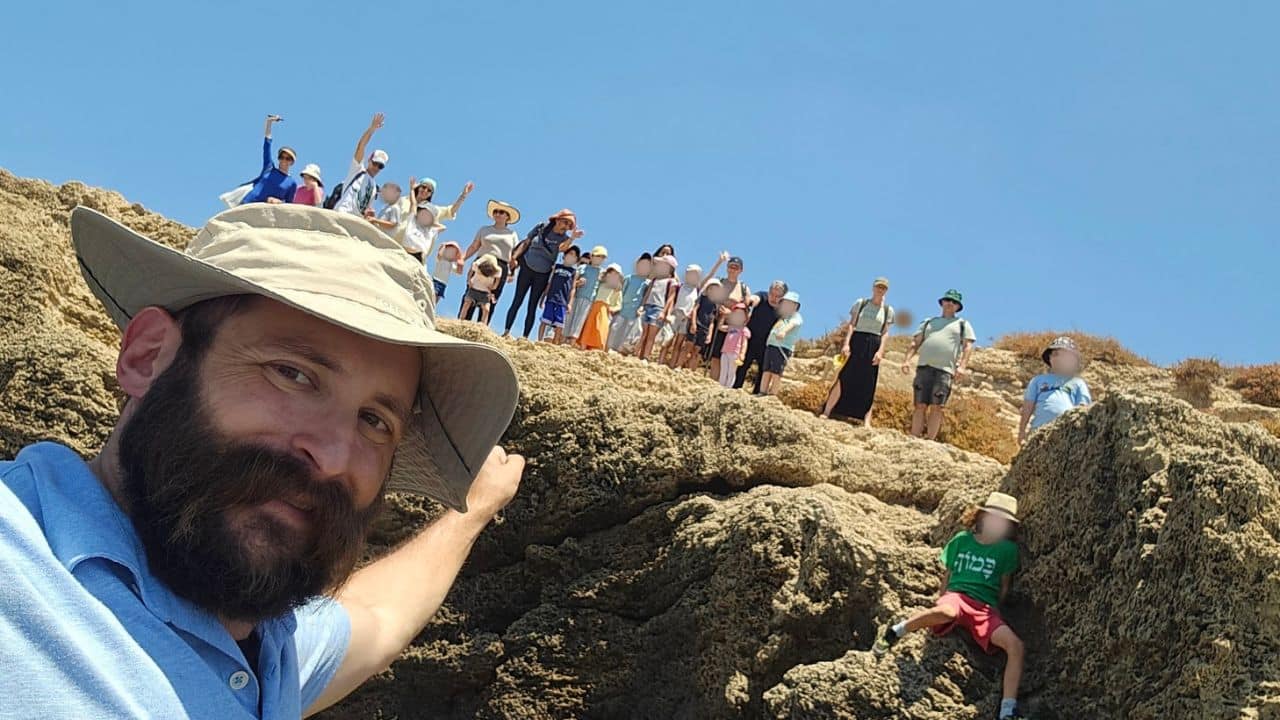
Visiting Tel Dor with my homeschooler history course in June 2026.
Tel Dor revealed Persian-period pits packed with crushed murex. And from the third century BCE, a two-pit installation joined by a lime-lined (where I am standing in the picture), capstone-covered drain — the southern pit full of broken shells, the northern one full of lumps of lime stained purple and pink, chemically confirmed as murex dye.[6]
Just up the coast is Tel Shikmona, on the southern edge of Haifa where the Carmel runs into the sea, a 2025 study led by Golan Shalvi and Ayelet Gilboa published 176 artifacts connected to dye production — 135 of them still stained purple, and the remains of at least 38 vats, some holding around 350 litres. The production runs continuously from roughly 1100 to 600 BCE, and from the ninth century it is an industry, not a household craft. The authors call it the largest such assemblage anywhere by two orders of magnitude.[3] The excavators go further: they argue Shikmona was most likely the supplier of dye to the Temple in Jerusalem.
If you want to see it, the National Maritime Museum in Haifa is running “The Color: Purple — Discovering Tel Shikmona and the Secrets of Purple” (הצבע: ארגמן), curated by Adi Shelach, open since June 2026 and advertised through April 2027. One of the four displays is called תכלת דומה לים. Hold that thought; we are coming back to it.
Next to Tel Dor sits the Mizgaga Museum at Kibbutz Nahsholim, which holds the Tel Dor collection. The building is itself a story: a glass factory put up in 1891 by Baron Edmond de Rothschild to make wine bottles for the Zichron Yaakov and Rishon LeZion wineries, managed for a time by Meir Dizengoff, later the first mayor of Tel Aviv. It closed within about four years, and that’s a story for another time.
Born in the Purple
By the Roman period, purple had become synonymous with royalty. Julius Caesar wore it. Augustus made it imperial. By the fourth century the true Tyrian purple was reserved to the emperor outright, and producing or wearing it without authorisation was treated as a crime against the state. Byzantine children born to a reigning emperor were porphyrogennetos — “born in the purple,” after the porphyry-lined chamber of the palace — and the phrase outlived the empire that coined it.
The prices are hard to hold in your head. Theopompus reports that at Colophon purple dye sold for its weight in silver. In Diocletian’s Price Edict of 301 CE, a pound of purple-dyed silk is capped at 150,000 denarii — the same ceiling the edict sets for a lion. This is what the Phoenician cities were sitting on: a monopoly on the ancient equivalent of luxury petroleum, and the demand drove murex populations across the Mediterranean toward collapse. The shell middens at Tyre and Sidon run metres deep.
Which brings us to a wall in Dura Europos, Syria. The synagogue at Dura Europos was completed in 244/245 CE and carries the most extensive cycle of Jewish biblical wall paintings to survive from antiquity. On the west wall facing Jerusalem, to the right of the ark-the Aron Kodesh-is the anointing of David by Samuel.
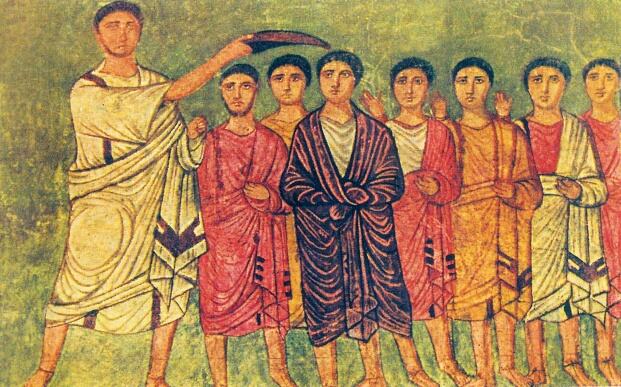
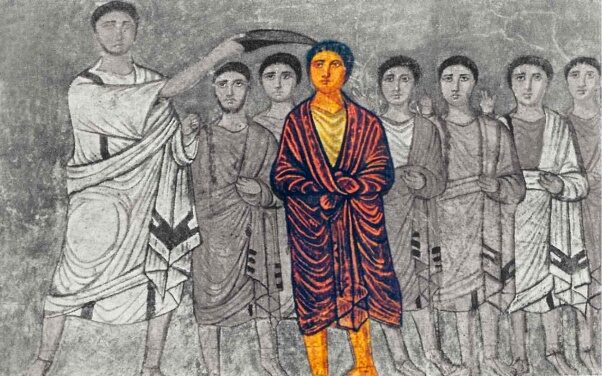
David is dressed in purple, which in the 3rd century roman city of Dura Europos would have meant royalty [8]. On the opposite side of the Ark, is another person robes in purple and also blue:
וּמׇרְדֳּכַי יָצָא מִלִּפְנֵי הַמֶּלֶךְ בִּלְבוּשׁ מַלְכוּת תְּכֵלֶת וָחוּר וַעֲטֶרֶת זָהָב גְּדוֹלָה וְתַכְרִיךְ בּוּץ וְאַרְגָּמָן׃
And Mordechai left the king’s presence in royal robes of blue and white, with a great crown of gold and a mantle of fine linen and purple.
Esther 8:15
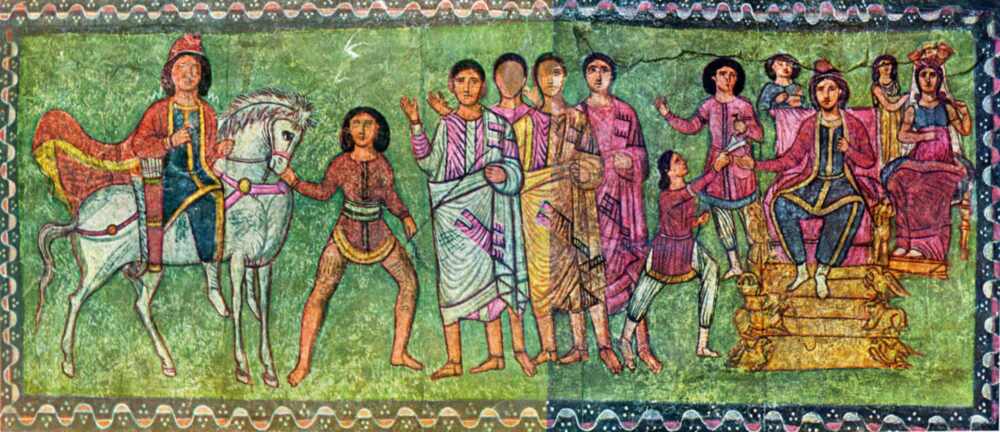
These paintings are in the National Museum of Damascus, and after years in which nobody knew what had become of them, a delegation was able to see them in September 2025 and reported them intact — and this is exciting news indeed.
Double-o-Blue: The Two Spies
The earliest depiction of the Spies we have comes from the mosaic floor of the ancient synagogue at Huqoq, in the Lower Galilee — two men, an enormous cluster of grapes slung on a pole between them, the verse spelled out above their heads. I wrote about that floor two weeks ago, when Samson was carrying the gates of Gaza across it.
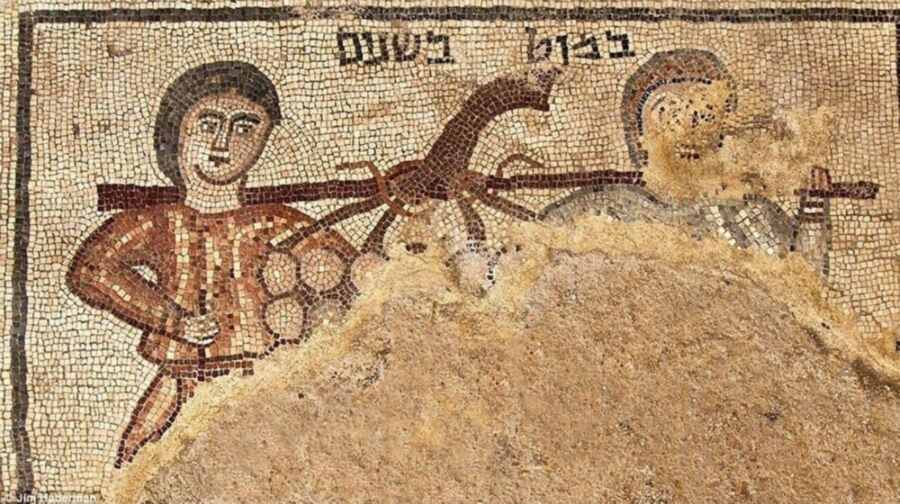
They were sent to do a specific thing:
אֵלֶּה שְׁמוֹת הָאֲנָשִׁים אֲשֶׁר־שָׁלַח מֹשֶׁה לָתוּר אֶת־הָאָרֶץ
These are the names of the men whom Moses sent to scout the land.
Numbers 13:16
Three chapters later — after the weeping, after the decree, at the very end of the same parasha — the tzitzit commandment arrives, and it reaches for the identical verb:
וְהָיָה לָכֶם לְצִיצִת וּרְאִיתֶם אֹתוֹ וּזְכַרְתֶּם אֶת־כׇּל־מִצְוֺת ה’ וַעֲשִׂיתֶם אֹתָם וְלֹא־תָתוּרוּ אַחֲרֵי לְבַבְכֶם וְאַחֲרֵי עֵינֵיכֶם אֲשֶׁר־אַתֶּם זֹנִים אַחֲרֵיהֶם׃
That shall be your fringe; look at it and recall all of God’s commandments and observe them, and do not scout after your heart and after your eyes, by which you go astray.
Numbers 15:39
Same root, תו”ר. Rashi makes the connection, based on the Talmud Yerushalmi: הַלֵּב וְהָעֵינַיִם הֵם מְרַגְּלִים לַגּוּף — “the heart and the eyes are the body’s spies.” The eye scouts, the heart wants, the body does. Espionage through the eyes. This makes for another curious Shiloh connection, which is in the portion of Ephraim, or Joseph. Joseph accuses his brothers of espionage:
וַיֹּאמֶר אֲלֵהֶם מְרַגְּלִים אַתֶּם לִרְאוֹת אֶת־עֶרְוַת הָאָרֶץ בָּאתֶם׃
And he said to them: You are spies. You have come to see the land in its nakedness.
Genesis 42:9
This is a profound accusation about how his brothers looked at the world as a place to opportunism and taking advantage. While he, Joseph, did not follow his eyes. I spoke about this in an event with Shiloh Winery — watch the clip (starts at 5:18).
Espionage, in a nutshell, is looking for the nakedness of a thing, looking for vulnerability. Hunting the seam, the weakness, the place where you could get leverage if you wanted it. The Spies were sent to see the land. They ended up taking advantage of their agendas, and causing a lot of damage.
The Twist
In his final words, Moses rebukes the generation in front of him, but sings about the future.
שִׁחֵת לוֹ לֹא בָּנָיו מוּמָם דּוֹר עִקֵּשׁ וּפְתַלְתֹּל׃
Corrupt are they, not His children, their blemish — a generation crooked and twisted.
Deuteronomy 32:5
The Netziv, in Ha’amek Davar, reads the two words as two destructions.[9]
עִקֵּשׁ — crooked, stubborn — is the First Temple. Idolatry, bloodshed, adultery, and done להכעיס, in open defiance. They did it out in the open, and so you can’t hide what the issues are. This makes it possible to address the issues. The Temple was rebuilt inside a lifetime.
וּפְתַלְתֹּל — twisted, plaited, tangled — is the Second Temple. And listen to what he actually says about that generation, because it is not what you expect a rebuke to say: שהיו עוסקים בתורה ועבודת ה’ — they were engaged in Torah and in the service of God. That was the problem. The bloodshed was לשם שמים, for the sake of Heaven. Anyone who transgressed was reclassified as a heretic, an informer, a legitimate target. Everything was justified, everything was principled, and everything was rotten. וְקָשֶׁה לְהַפְרִיד הַטּוֹב מִן הָרָע — and it is hard to separate or unweave the good from the bad, because the bad was done in the name of Heaven.
Now the twist: פְּתַלְתֹּל and פְּתִיל תְּכֵלֶת. Both deal with destruction through being twisted, warped, unbalanced. The sin of the second Temple was a lot harder to put a finger on, just like it’s hard to figure out how the righteous leaders of the tribes of Israel became the spies. It’s always for the greater good.
From the Depths of the Sea to the Stars
Here is what I think is the most profound connection between the tekhelet from Shiloh and Tisha b’Av + Tu b’Av.
The tekhelet of the snail is the color of the ocean where life on this planet began. We use a rather primitive life form, which has within it – through exposure to the sun – the potential to break out of our primitive pettiness, and reach the sky:
תַּנְיָא, הָיָה רַבִּי מֵאִיר אוֹמֵר: מָה נִשְׁתַּנָּה תְּכֵלֶת מִכׇּל מִינֵי צִבְעוֹנִין? מִפְּנֵי שֶׁהַתְּכֵלֶת דּוֹמֶה לַיָּם, וְיָם דּוֹמֶה לָרָקִיעַ, וְרָקִיעַ לְכִסֵּא הַכָּבוֹד.
It is taught in a baraita that Rabbi Meir would say: What is different about tekhelet from all other types of colors, that it was chosen for the mitzvah of ritual fringes? Because tekhelet is similar to the sea, and the sea is similar to the sky, and the sky is similar to the Throne of Glory.
Menachot 43b[10]
The primal issue with the spies, and the twisted generation of the Second Temple, is that we are stuck in out pettiness. We see things a certain way, and can’t get out of our heads. We become spies, with our reptilian brains in search of vulnerability, looking to take advantage. Things have to go our way, and we are always right, and God is on our side.
The introduction of tekhelet is there to remind us that there is something bigger than us, deeper than us, even in the simplest life forms. We can learn both to be humble, and to dream big, to reach the stars. This might be a bit of a stretch, but it speaks to me very powerfully.
Furthermore, the essence of Tu b’Av is יוֹם שֶׁהוּתְּרוּ שְׁבָטִים לָבוֹא זֶה בָּזֶה. It’s the breaking away from tribalism that forbade marriage between tribes in the generation of the desert. The spies, the tribal leaders in the desert, feared the shift from the tribal communities in the desert into the land of Israel, and perhaps thought they were saving Israel from a new reality they weren’t prepared for. But that tribalism would have destroyed us!
Why? Because Tu b’Av also marks the end (in Shiloh!) of a civil war:יוֹם שֶׁהוּתַּר שֵׁבֶט בִּנְיָמִין לָבוֹא בַּקָּהָל — the day the tribe of Benjamin was permitted back into the congregation, after they were almost completely destroyed:[11]
וַיֹּאמְרוּ הִנֵּה חַג־ה’ בְּשִׁלוֹ מִיָּמִים יָמִימָה… לְכוּ וַאֲרַבְתֶּם בַּכְּרָמִים… וַחֲטַפְתֶּם לָכֶם אִישׁ אִשְׁתּוֹ מִבְּנוֹת שִׁילוֹ
And they said: the annual festival of the Lord is at Shiloh… Go and wait in the vineyards… and each of you seize a wife from the daughters of Shiloh.
Judges 21:19–21
This snail wasn’t just out of the blue. It was all about the blue. The ability to look up, see a bigger picture, and move towards new solutions and breaking away from old and outdated thinking that gets us stuck…in our own shell.
What are your thoughts about this? Do you agree or disagree with any of the points I make here? Let me know your thoughts.
Bonus: Color of Return
I invite you to watch this year’s free Tisha b’Av virtual tour and class: Color of Return: A Tisha b’Av Journey Through Color and Restoration — built around some of these ideas. I talk more about colors, a few of the paintings Dura Europos, as well as other mosaics and masterpieces that relate to this time of year.
Endnotes
[1] Purim 2019: IAA release, 19 March 2019. Hanukkah 2021: IAA release, 16 November 2021. Hanukkah 2022: IAA release, 13 December 2022 (the hoard is from Muraba’at Cave, Nahal Darga, and was displayed for the festival at the Hasmonean Museum in Modi’in). Tisha b’Av 2026: City of David charred beams, announced 20 July 2026; Dr. Efrat Bocher quoted in the Jerusalem Post and Times of Israel.
[2] IAA announcement 1 March 2023; retraction 3 March 2023, issued by Prof. Gideon Avni, IAA Chief Scientist. The inscription had been read by Dr. Haggai Misgav (Hebrew University) and Sa’ar Ganor (IAA). The scholar responsible was supervised by Dr. Katharina Streit of the Austrian Academy of Sciences; her name was not published. See Times of Israel and the full Hebrew release at Davar.
[3] Golan Shalvi, Naama Sukenik, Paula Waiman-Barak, Zachary C. Dunseth, Shay Bar, Sana Pinsky, David Iluz, Zohar Amar and Ayelet Gilboa, “Tel Shiqmona during the Iron Age: A first glimpse into an ancient Mediterranean purple dye ‘factory’,” PLOS ONE 20(4): e0321082 (16 April 2025). Earlier excavations at the site were conducted by Joseph Elgavish for the Haifa Museums, 1963–1977.
[4] Seder Olam Rabbah 11; the baraita at Zevachim 118b gives the same figure as “three hundred and seventy less one.”
[5] Otto Elsner and Ehud Spanier, 1980. R. Isaac Herzog had already identified Murex trunculus as the most likely candidate in his 1913 doctoral work, but could not obtain a pure blue with the methods then available — the photochemistry is what closed the gap.
[6] Jessica L. Nitschke, S. Rebecca Martin and Yiftah Shalev, “Between Carmel and the Sea: Tel Dor, the Late Periods,” Near Eastern Archaeology 74.3 (2011): 132–154. Note that a separate Roman-period complex at Dor, long described as a purple dye works, was reinterpreted in 2025 as a fish-processing facility — see Reece et al., IJNA 54.2 (2025).
[7] A splendid coincidence for a post about dye. The Academy of the Hebrew denies any connection to the word purple. סְגֻלָּה is a treasured possession; the color word סָגֹל was coined in the nineteenth century by Rabbi Yechiel Michel Pines, from סִגָּל, the violet. האקדמיה ללשון העברית, “סגולה וסָגול”.
[8] “David is dressed in a purple garment, the prerogative of a king, which proleptically indicates his royal status.” Kurt Weitzmann and Herbert L. Kessler, The Frescoes of the Dura Synagogue and Christian Art, Dumbarton Oaks Studies 28 (1990), 80.
[9] Naftali Zvi Yehuda Berlin (1816–1893), head of the Volozhin Yeshiva from 1853/54 until the Russian authorities forced its closure in 1892. Ha’amek Davar on Deuteronomy 32:5; he cross-references his own comment at Numbers 35:34. Translations here are my own.
[10] The parallel at Chullin 89a runs the chain one link longer — sea, sky, sapphire stone, Throne of Glory — picking up the sapphire of Exodus 24:10 and Ezekiel 1:26 that the Menachot version cites as proof texts.
[11] Ta’anit 30b, on the reasons the fifteenth of Av is a festival; the Benjamin episode is Judges 19–21. Sefaria: Ta’anit 30b, Mishnah Ta’anit 4:8, Judges 21:19–23, Isaiah 54:11.


