
Blog post for Parashat Devarim 5786/2026
“Who is a giant? He who carries the gates of Gaza on his shoulders!”
Caution: Giants!
“What is the difference between your expectations and the reality of Israel?” my parents asked a group of Australian teenagers visiting Israel for the first time, seated in my parents’ living room in the Jewish Quarter of Jerusalem. “We thought the streets would be paved with gold,” they said.
Well, before entering the Land, Moses gives the Israelites rather different advance notice — not streets of gold, but… giants!
Whither shall we go up? Our brethren have taken the heart out of us, saying: The people is greater and taller than we; the cities are great and fortified up to heaven; and moreover we have seen the sons of the Giants there. (Deuteronomy 1:28)
Hear, O Israel: thou art to pass over the Jordan this day, to go in and dispossess nations greater and mightier than thyself, cities great and fortified up to heaven. A people great and tall, the sons of the Giants, whom thou knowest, and of whom thou hast heard say: “Who can stand before the sons of Giants?” (9:1–2)
But is being a giant necessarily a problem? Israel had its own superheroes — giants who could carry an entire city gate on their shoulders!
That, at least, is how Samson is depicted on the mosaic floor of the ancient synagogue at Huqoq. If you want to see this mosaic, it is now on display for the very first time at the Yigal Allon Center in Kibbutz Ginosar.
At the exhibition “Secrets of Huqoq”, you’ll encounter one of the most fascinating archaeological sites discovered in Israel in recent years. Alongside the Samson panel, you’ll see photographs of other mosaics still lying in place at the site — it will be years before Huqoq is ready for public visits. I’ve written about several of these panels before, including the zodiac, the spies with the grapes, and Samson himself.
What is perhaps less well known is that this discovery sheds light on another mosaic — from a different ancient synagogue, at a site called Khirbet Wadi Hamam, also in the Lower Galilee — now displayed at the Israel Museum. Its label reads: ‘A Battling Giant’ — and leaves the identification open, suggesting either Samson fighting the Philistines or Goliath battling the Israelites.
Imagine you encounter this mosaic for the first time, with no prior knowledge or preconceptions. How would you read the scene?
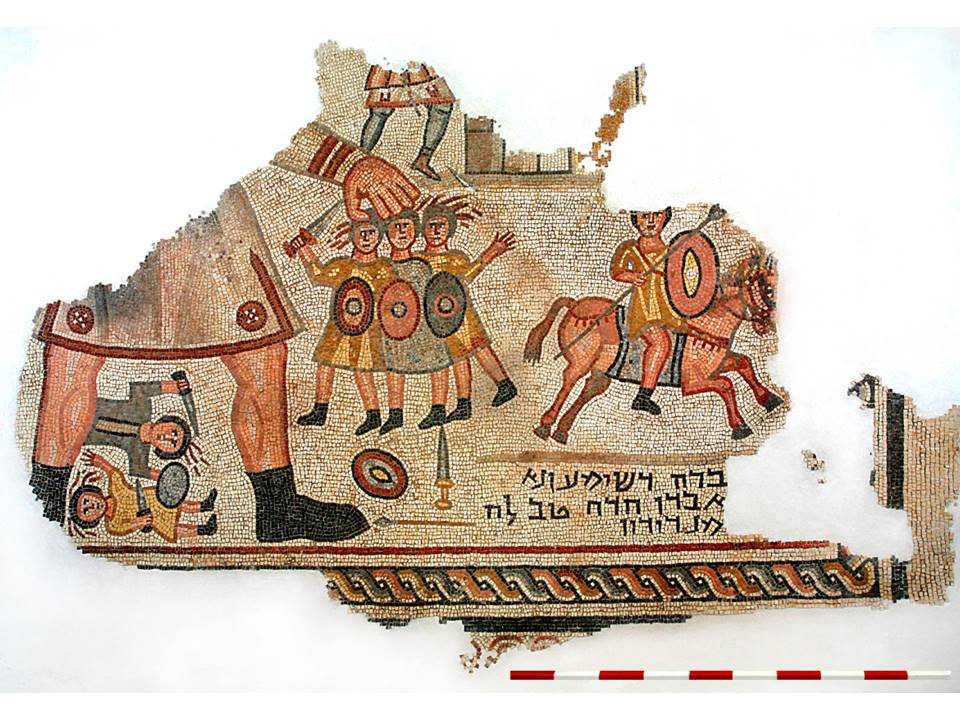
There are two stories in the panel — and the “giant” in the background may be the same figure appearing again in the foreground, though that isn’t entirely clear. In the foreground, the giant grips three armed figures; beneath his feet, two have fallen. To the right, an armed horseman flees at full gallop. Below the horseman, a fragmentary Aramaic inscription reads: bar d’Shim’ona… avdu hada tavla… minidodon — “the son of Shimon… made this tablet… from his donation.” The Aramaic (and its spelling errors) is a subject for another time. The inscription tells us nothing about the scene itself.
Before I tell you more about the two sites, let’s first look at the mosaic on display now in Ginosar:
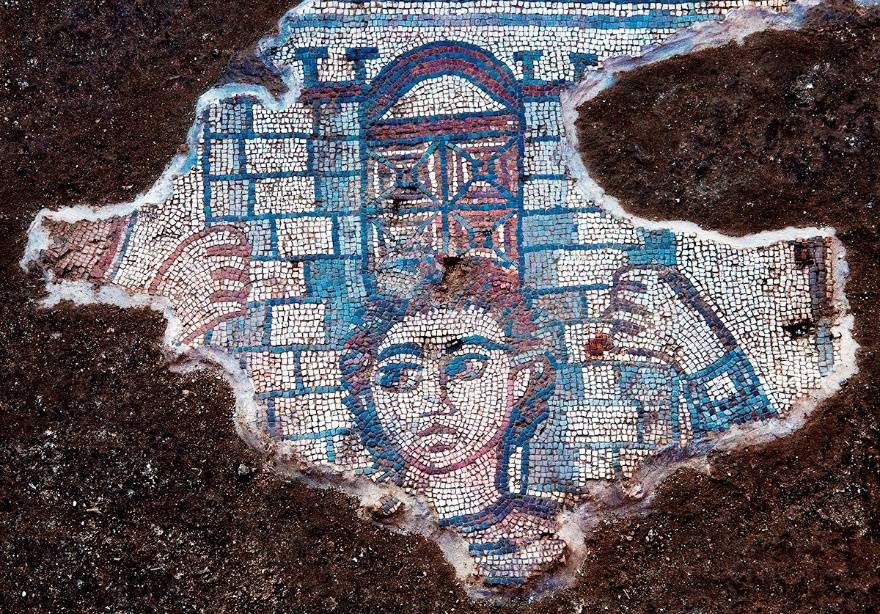
The giant figure is Samson carrying the gates of Gaza on his shoulders, based on Judges 16:3: “And Samson lay till midnight, and arose at midnight, and took hold of the doors of the gate of the city, and the two posts, and plucked them up, bar and all, and put them upon his shoulders.”
Now back to the Israel Museum giant — Wadi Hamam — and notice the figure in the background. If this is Samson, he’s approaching the gates of Gaza, about to pull them from their posts. But the foreground — what’s happening there?
Before we answer, here is another Huqoq mosaic, one that leaves no room for doubt:
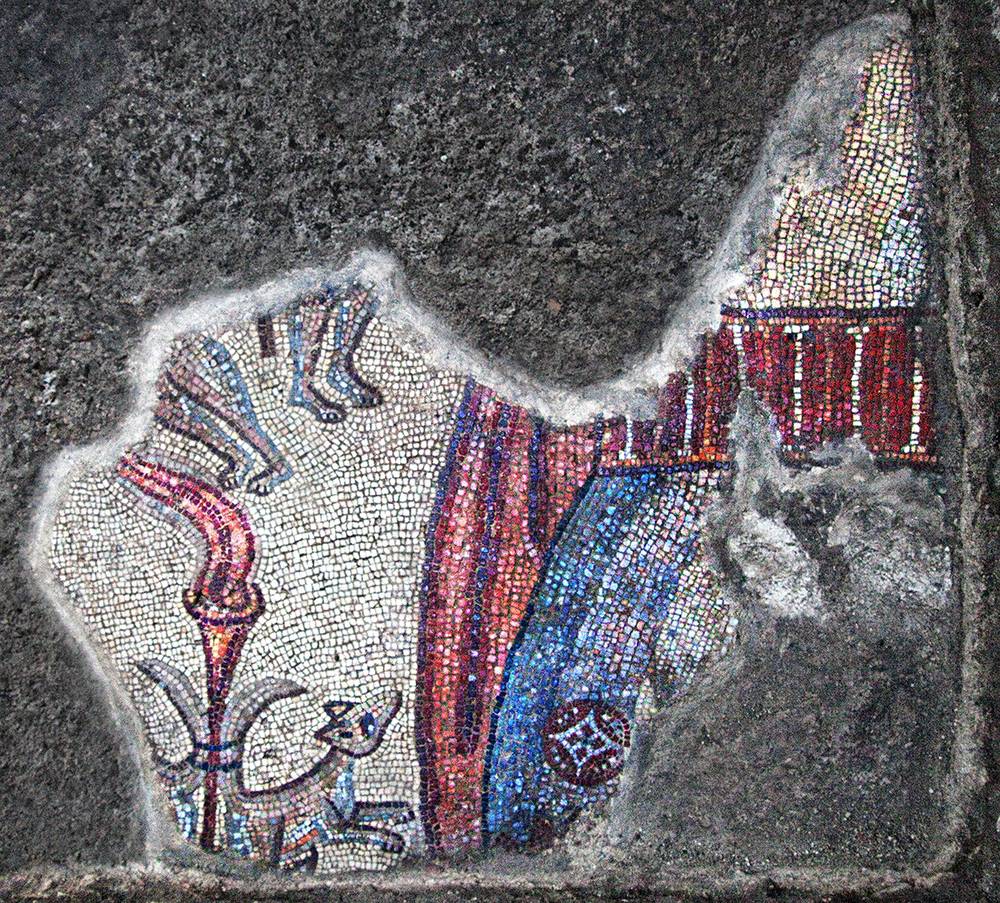
A large figure — once again a giant — holds foxes tied tail-to-tail with a torch between them. Above, another pair of legs and the bottom of another torch are visible. Based on Judges 15:4–5: “And Samson went and caught three hundred foxes, and took torches, and turned them tail to tail, and put one torch between every two tails in the midst. And when he had set the torches on fire, he let them go into the standing grain of the Philistines.”
Can you imagine what the full image would have looked like?
So — what is happening in the Wadi Hamam foreground? Most likely Samson striking the Philistines with the jawbone of an ass, based on Judges 15:15–16: “And he found a new jawbone of an ass, and put forth his hand and took it, and smote a thousand men therewith. And Samson said: With the jawbone of an ass, heaps upon heaps, with the jawbone of an ass have I smitten a thousand men.” It rhymes better in Hebrew, but still, a warrior-poet!
Samson: not only a giant — also witty.
By the way — where does his giant status even come from? Let’s set that aside for a moment and look at the two sites.
Huqoq was excavated by Prof. Jodi Magness (University of North Carolina) from 2011 to 2023, with 2023 being the final season. Huqoq is mentioned in Joshua 19:34 as a boundary marker in the territory of Naphtali. Khirbet Wadi Hamam, at the foot of Mount Arbel, was excavated between 2007 and 2012 by Prof. Uzi Leibner (Hebrew University).1 The site is identified with Migdal Tzab’aya, known from the Talmud as a center for fabric dyeing.
The two synagogues are roughly six to seven kilometers apart, and they were probably in use within a span of decades or centuries of each other — somewhere between the late third and fifth centuries CE, the Talmudic period.
The similarity between the two mosaic programs is remarkable. As an example, here is the Tower of Babel, from both sites:
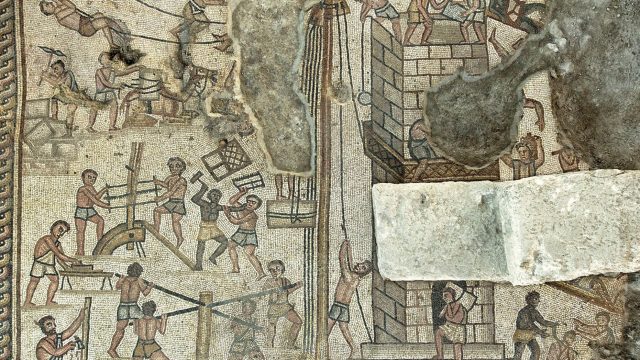
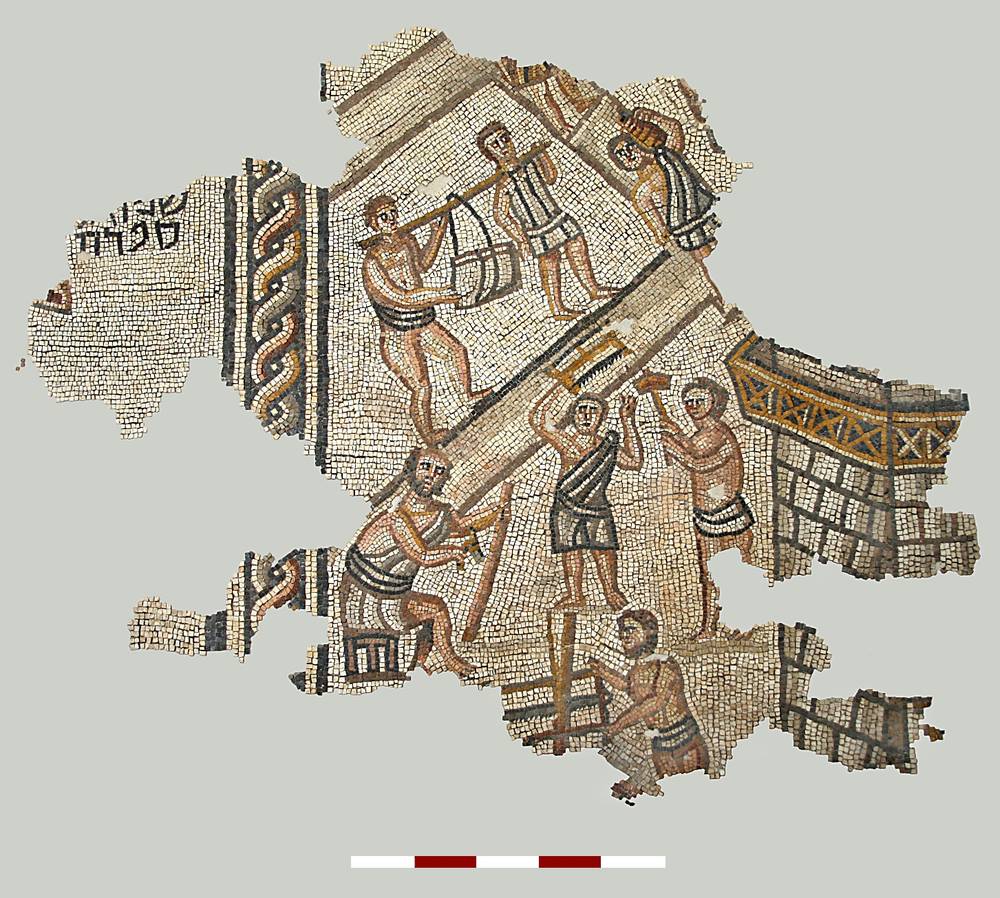
The resemblance between the two sites — and their proximity — led scholars to conclude they were produced by the same workshop.2 But there is a live debate about how to date them.
When, Exactly? A Productive Disagreement
Leibner dates Wadi Hamam to the third through early fourth century CE, based on stylistic analysis — comparing the mosaics to the conventions of Roman provincial art of the period.
Magness dates Huqoq to the late fourth through early fifth century CE, based on stratigraphic excavation — reading what sealed deposits reveal about the sequence of use. More recently, a radiocarbon study published in PLOS One (2025) supported her conclusions.3
The implication shifts depending on who is right. If Leibner is correct: Jews built monumental synagogues during a window of relative Roman tolerance. If Magness is correct: they built them under Christian Byzantine rule, in a period that required considerably more determination. Both pictures are remarkable. Just differently remarkable.
The Diaspora’s Giant
Now a third mosaic enters the picture — from Turkey. In the 1950s, an ancient building with a magnificent mosaic floor was excavated at Mopsuestia — modern-day Misis, near Adana in southern Turkey. The floor depicted cycles of Samson and Noah scenes. But the building was almost entirely destroyed — it lies today under a school — and most of the images are gone. All that remains are photographs taken during the excavation and published some years later.
Pay attention to the giant figure. If this is Samson, what is the story? And do you notice the resemblance to Samson’s depiction across all three mosaics? I say “three mosaics” deliberately rather than “three synagogues,” because scholars have not reached consensus on whether the Mopsuestia building was a synagogue or a church. Churches of this period were known for depicting biblical narratives, which complicates the identification. The original excavator called it a church. Others — including Rachel Hachlili and Israel L. Levine — argued synagogue, based on the striking parallel to other Jewish mosaic programs.4 Seventy years after the excavation, there is still no agreement.
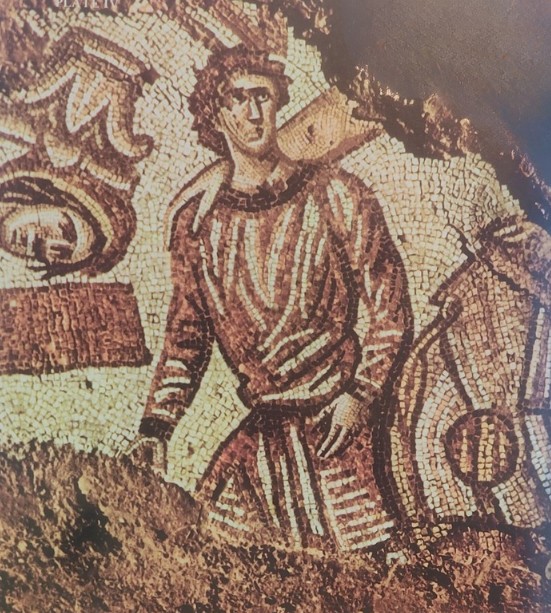
The Same Coat
The image is fragmentary, but there are clues.
First: the figure is enormous. Which brings us back to the question we set aside — where does Samson’s giant status come from? The answer lies in Midrash and Talmud — in rabbinic tradition. The Talmud (Sotah 9b–10a) describes Samson in terms that leave no ambiguity about how the Chazal imagined him. These mosaics are from the Talmudic period — so this reading was not a distant theory but a living one.
Second: in all three mosaic programs, Samson wears the same garment — a tunic decorated with round ornamental patches at the hem and shoulders called orbiculi (“sphere-shaped”). Same figure, same coat, three different sites, possibly three different decades, spanning the eastern Mediterranean.
Why the same clothing across mosaics separated by geography and time? Some scholars suggest this can only be explained by a shared prototype — an illustrated compendium of biblical figures and scenes, circulating across the Roman-Byzantine world, from which artists drew their models. Imagine finding such a book! Such a book, if it existed, has not survived. But its traces may be visible here: in the coat Samson wears in the Lower Galilee, in Ginosar’s exhibition, and in a ruined building in Turkey whose identity we still debate.
And what is the scene? Samson blinded, led by a youth, inside the Dagon temple — the moment before the end. Based on Judges 16:27–30: “And Samson said unto the lad that held him by the hand: Suffer me that I may feel the pillars… And Samson said: Let me die with the Philistines. And he bent with all his might; and the house fell upon the lords, and upon all the people that were therein… and the dead that he slew at his death were more than they that he slew in his life.”
Why Samson?
I want to leave you with the question I find hardest to answer.
Samson was a complicated figure, perhaps a wildcard, by modern Jewish standards, and even back in his own time. He had strange ways of picking battles with the Philistines, married and dated their women, and ended his life by pulling down a temple with his bare hands. He is not a figure of uncomplicated heroism. The rabbis who discussed him at length in Sotah 9b did not gloss over his contradictions. And some things they say about him are not for young ears.
And yet: two communities in the Lower Galilee — possibly three, if Mopsuestia counts — chose to put his image on the floor of their synagogue. What questions does this raise for you? I would love to hear them! Personally, I also wonder about the things a common Jew at the time would think about when he or she would walk into the synagogue.
But if you want to go look at one of these floors for yourself, the Ginosar exhibition is open now. The original Huqoq mosaic — Samson, enormous, carrying the gates of Gaza — is the first thing you see when you walk in. The rest of the Huqoq mosaics are being prepared for public view on site, and that will take a few years. But it’s worth the wait!
Endnotes
[1] Uzi Leibner and Shulamit Miller, “A Figural Mosaic in the Synagogue at Khirbet Wadi Hamam,” Journal of Roman Archaeology 23 (2010): 238–264. Full site report: Uzi Leibner, Khirbet Wadi Ḥamam: A Roman-Period Village and Synagogue in the Lower Galilee, Qedem Reports 13 (Hebrew University, 2018).
[2] Jodi Magness, The Mosaics of the Huqoq Synagogue and Their Meaning (Society of Biblical Literature, 2018), 119.
[3] Jodi Magness et al., “Radiocarbon dating of the Late Roman synagogue at Huqoq, Israel,” PLOS One (2025).
[4] Rachel Hachlili, Ancient Synagogues — Archaeology and Art (Brill, 2013); Karen Britt and Ra’anan Boustan, “Samson in the Galilee — and Beyond,” Studies in Late Antiquity 8/4 (2024): 481–.


